Minister Ordination Certificate
Have you been asked to perform a wedding? Have you always felt called to serve others as a spiritual life coach, counselor, or member of the clergy?
Answer the call
Put your spiritual calling into recognized ministerial service
As an ordained minister, you may be able to perform marriages, receive donations for ministerial services, establish a church, ministry, nonprofit, or wedding chapel, and offer spiritual or pastoral counseling. You may also pursue tax-exempt status for a qualifying organization.
Your credentials can support a spiritual counseling or healing practice, community ministry, hospital or prison ministry, wedding officiation, or the creation of your own church or ministry. Feel good about what you do. Make a living doing what you were meant to do and what you love to do.
The Interfaith Minister is our most popular title. Interfaith ministers are often called upon to heal gaps among differing religious faiths. This can be a meaningful choice if you plan to officiate weddings, work in prison or hospital ministry, or be active in your community.
To be ordained as an Interfaith Minister means recognizing positive spiritual paths regardless of denomination, including healing and earth-based traditions, without judgment against other valid spiritual faiths. It is also an excellent choice for those who consider themselves multi-faith ministers.
As an ordained minister, you can pursue
- Authority to perform marriages, subject to state and local requirements.
- Acceptance of donations for qualifying ministerial services.
- The establishment of your own church, ministry, nonprofit, or wedding chapel.
- Spiritual and pastoral counseling within the scope allowed by applicable law.
- Tax-exempt recognition for an organization that independently qualifies.
A certificate made to be presented
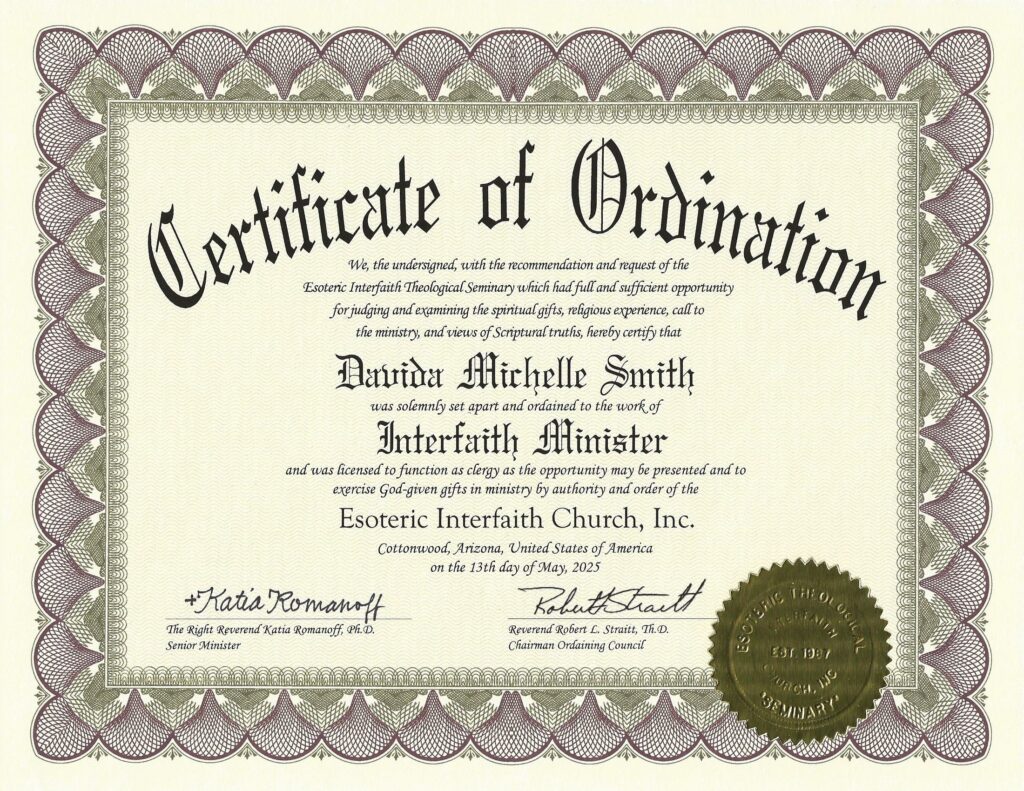
Authorized third-party sample
This photograph shows a certificate issued by Esoteric Interfaith Church, Inc. and is displayed with authorization as an example of formal certificate quality. It is not an Entheogenic Church Resources certificate and does not represent the exact artwork, wording, seal, or issuing organization of the credential offered here.
Formal, physical credentials
Your Certificate of Ordination is signed in person by real people and printed on special certificate paper rather than printed at home. A bona fide certificate with a raised seal can provide a tangible record when verification of your ministerial standing is requested.
Ongoing record support
Verification, letters of good standing, letters of reference, and guidance with marriage-license paperwork may be available when needed. There are no annual renewal fees: the ordination is not temporary and does not expire under the issuing body's ecclesiastical standards.
Optional clergy identification
Photo Badge Clergy ID Card · $30
After completing your application, you may order a Minister or Rabbi photo badge for use in settings such as prison or hospital ministry. Access and acceptance are determined by each institution and its own credentialing rules.
A meaningful path of service
People often turn to clergy for ceremony, counsel, healing, and community support, especially in difficult seasons. Non-denominational and alternative ministers can serve people seeking spiritually inclusive care and guidance.
Confirm local requirements

IX · Begin
Your calling deserves a structure of its own.
Tell us about the 508(c)(1)(A) entheogenic church & ministry you intend to build. We will walk you through the documents, implementation, and questions that belong with licensed counsel.